Flat roof waterproofing in Paris: which membrane to choose in 2026?
Karim·April 28, 2026·9 min
What is flat roof waterproofing?
Flat roof waterproofing is a technical waterproof protection system applied to the surface of a flat or low-pitched roof, designed to prevent any water infiltration into the building structure while withstanding the thermal, mechanical and climatic constraints of the site.
A Parisian flat roof is a complex structure subject to severe constraints: winter frost, intense summer heat (surface temperatures up to +80°C), maintenance foot traffic, weight of technical equipment and hygrometric variations. The right waterproofing membrane determines not only the impermeability of the structure but also its lifespan, maintenance costs and ability to accommodate additional uses (accessible terrace, green roof).
Terrace Waterproofing
No more leaks: continuous liquid membranes and guaranteed solutions.
Discover this serviceParisian flat roof specifics
Climate constraints: Paris has a temperate oceanic climate, but flat roofs experience significant thermal swings — from -15°C in winter to +80°C at the surface in summer. These thermal cycles are very aggressive on waterproofing membranes and require materials with high expansion-contraction capacity.
PLU and roof access: In Paris intra-muros, PLU rules often regulate flat roof use (parapet heights, materials visible from the street). In apartment buildings, roof access must be preserved for maintenance, requiring appropriate mechanical protection (paving slabs on pedestals, circulation paths).
Load considerations:
- Inaccessible roof: maintenance only, light protection
- Accessible roof: private or shared terrace, requires heavy protection and high mechanical strength
- Green roof: substrate weight (80–300 kg/m²), requires root-resistant waterproofing
The 4 main waterproofing systems
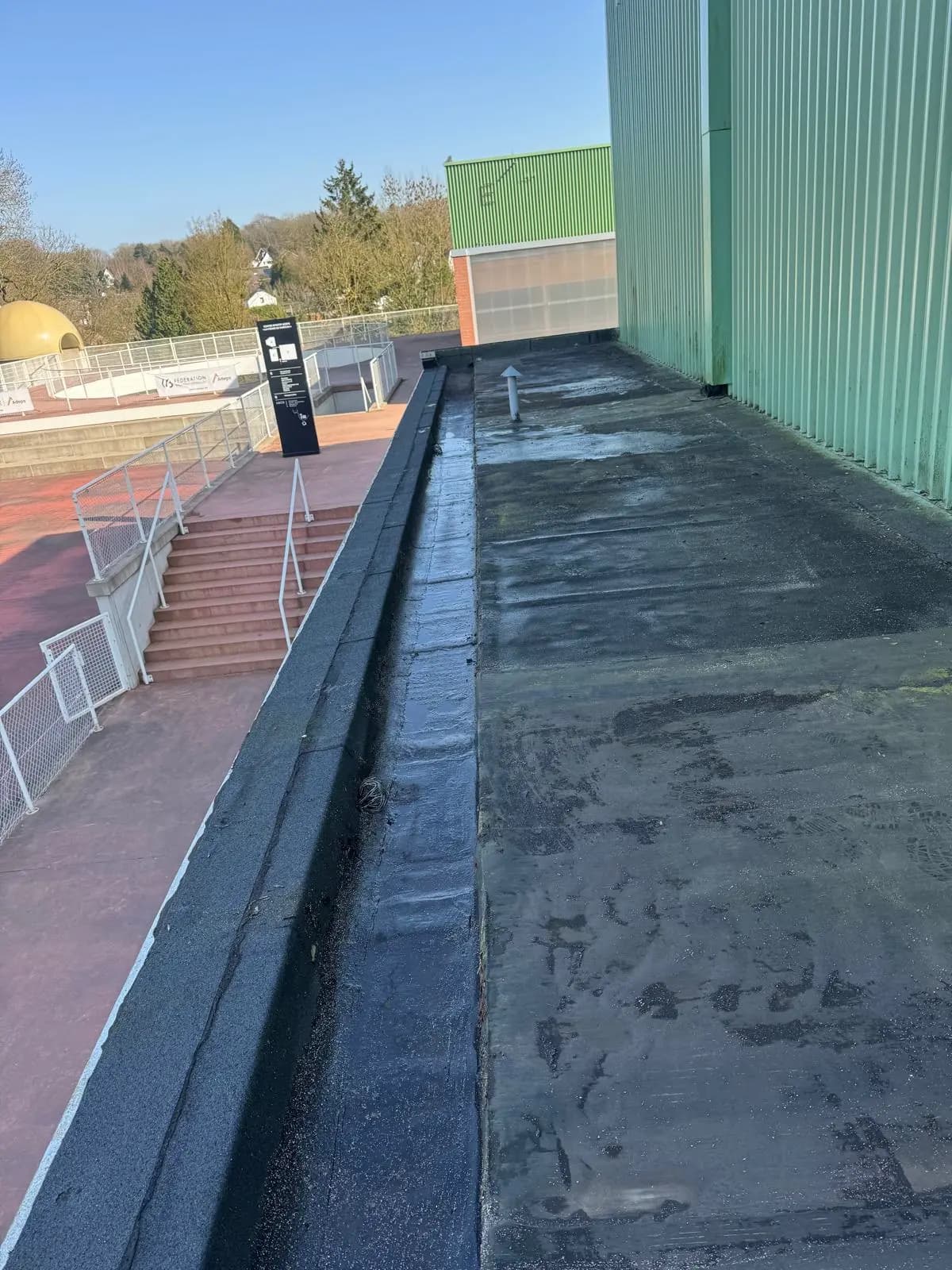
1. Bituminous membrane (SBS or APP modified bitumen)
The most widely used system in France, with decades of proven performance. Modified bituminous membranes with SBS (elastomer) or APP (plastomer) polymers offer excellent performance.
Performance: Lifespan 15–25 years | Good UV resistance | Excellent repairability
Installed price: €40–90/m²
Advantages: Proven long-term durability, easily repairable, compatible with all substrates, wide range of thicknesses and performances, controlled cost.
Disadvantages: Torch application requires fire precautions, poor aesthetics without surface protection, UV-accelerated ageing if left exposed.
Best for: Inaccessible roofs, large industrial or commercial surfaces, cost-effective renovation of existing roofs.
2. Liquid waterproofing resin (SEL)
Applied cold by roller or trowel, liquid resin cross-links in place forming a continuous membrane without joints or welds. Types include polyurethane (PU), PMMA (ultra-fast curing, 30 min) and epoxy.
Performance: Lifespan 20–25 years | Good UV resistance with additives | Excellent repairability
Installed price: €60–130/m²
Advantages: Continuous jointless membrane eliminates weak points, ideal for complex substrates (balconies, loggias, irregular shapes), cold application — no fire risk, excellent aesthetics (multiple colours).
Disadvantages: Higher cost than bitumen, sensitive to residual substrate moisture (must be perfectly dry), requires expertise for upstands and angles.
Best for: Parisian balconies, loggias, accessible flat roofs with complex shapes, renovation without removing existing covering.
3. EPDM membrane (Ethylene Propylene Diene Monomer)
EPDM is a high-performance synthetic rubber used since the 1960s in the US and increasingly popular in France. It is supplied in large sheets welded chemically on site.
Performance: Lifespan 30–50 years (best in class) | Exceptional thermal resistance (-40°C to +120°C) | Excellent UV resistance
Installed price: €60–130/m²
Advantages: Exceptional lifespan — best long-term ROI, very lightweight (~1.4 kg/m²), excellent compatibility with green roofs (root resistance), near-zero maintenance, 100% recyclable.
Disadvantages: Higher initial cost, demanding installation at junctions (quality of chemical welds is critical), less suited to very irregular substrates.
Best for: Green roofs, large residential or commercial flat roofs, projects prioritising maximum durability.
4. PVC membrane
Thermally-welded PVC membrane is widely used in commercial construction. It offers a good durability/cost ratio with rapid installation.
Performance: Lifespan 20–30 years | Good UV resistance | Excellent chemical resistance
Installed price: €50–110/m²
Comparison table
| Criterion | SBS Bitumen | Liquid resin | EPDM | PVC |
|---|---|---|---|---|
| Lifespan | 15–25 yrs | 20–25 yrs | 30–50 yrs | 20–30 yrs |
| Installed price | €40–90/m² | €60–130/m² | €60–130/m² | €50–110/m² |
| Balcony/loggia | ✓ | ✓✓ | ✓ | ✓ |
| Large surface | ✓✓ | ✓ | ✓✓ | ✓✓ |
| Green roof | ✓ | ✓ | ✓✓ | ✓ |
| Cold application | ✗ | ✓✓ | ✓ | ✗ |
| Repairability | ✓✓ | ✓✓ | ✓ | ✓ |
| Maintenance | Medium | Low | Very low | Low |
How to choose the right system
Parisian balcony or loggia → Liquid resin SEL: continuous jointless membrane, perfect for small complex surfaces, cold application.
Large inaccessible flat roof → SBS bitumen or PVC: best value on large surfaces.
Green roof → EPDM: maximum lifespan, root resistance, lightweight.
Accessible terrace (private use) → Liquid resin SEL or EPDM under paving slabs on pedestals: mechanical resistance, aesthetics and durability for daily-use terraces.
FDM ENERGIE carries out complete waterproofing diagnostics across Paris and Île-de-France. Our experts assess your flat roof condition and recommend the most appropriate system for your situation. Contact us for a free diagnostic and personalised quote.